Mowat comes face to face with his first wild wolf
Never Cry WolfFarley Mowat comes face to face with his first wild wolf after mistaking its distant cries for those of a lost dog. The encounter turns a hopeful rescue into a sudden test of nerve: at the top of a ridge, Mowat discovers that the animal he has been pursuing is a full-grown arctic wolf, only a few feet away. The wolf bolts, Mowat retreats to his cabin, and what lasts only moments becomes his first direct contact with the species he has come to study.
Setting and mistaken expectation
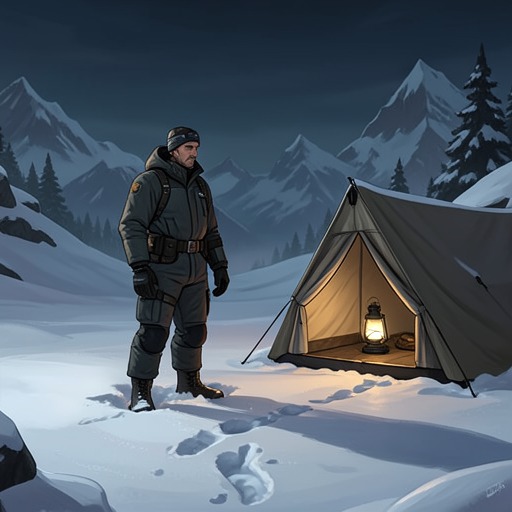
The meeting follows the arrival of spring on the Barrens. Rapid snowmelt had overwhelmed the frozen rivers; after the ice broke and jammed, water entered Mowat’s cabin and left its floor covered with debris from the long winter. He moved his tent to a gravel ridge above the cabin. That evening, while trying to sleep, he heard unfamiliar cries across the river to the north.
The sounds seemed to Mowat like whines, whimpers, and small howls. Remembering an earlier mistake, he decided they came from a young Husky dog rather than a wolf. He reasoned that one of Mike’s three half-grown pups, which were not yet harness-trained and ran loose behind the team, might have become lost and returned to the cabin. The explanation made the cries a possible appeal for company, not a threat, and Mowat was delighted at the chance to befriend the supposed pup.
The approach across the river
Mowat dressed quickly, launched his canoe, and paddled to the far bank. He planned not to call out: an unfamiliar human voice, he thought, might frighten the animal away. Instead, he would approach quietly and offer reassurance only when he was close enough. The choice shaped the encounter. His effort to avoid startling a lost dog brought him into close range of a wild wolf before he understood what he was following.
Although the cries had seemed to come from only a short distance away, Mowat crossed broken boulders and gravel ridges without gaining on them. Their volume seemed unchanged as he moved, and he supposed the pup was retreating out of shyness. When the whimpering stopped, he lost the sound as a guide but continued toward a steep ridge, hoping its summit would give him a view. Near the crest, he lowered himself to the ground and inched forward, using fieldcraft learned in the Boy Scouts.
The face-to-face encounter
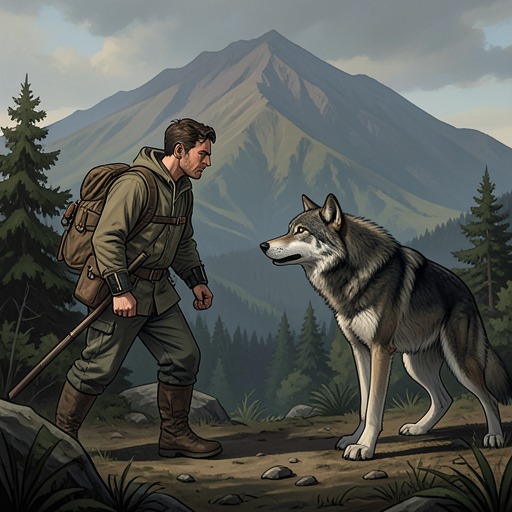
As Mowat’s head rose over the ridge, he found the animal lying down, apparently resting after its mournful calls. Its nose was about six feet from his. The two stared at one another in silence. Mowat recognized that the supposed pup was a fully grown arctic wolf, probably heavier than he was and far more practiced in close combat. The scene’s reversal is immediate: he had crossed the river eager to comfort a young dog, but now faced a powerful wild animal at nearly touching distance.
Neither moved for several seconds. Then the wolf broke the stillness, leaping about a yard into the air before running off. Mowat recalled that textbooks gave a wolf’s speed as twenty-five miles an hour, but what he saw looked less like ordinary running than low flight. Within seconds, the animal had disappeared from sight. The encounter contains no attack or pursuit by the wolf; its decisive action is to leave, while the danger Mowat anticipates remains a measure of his own sudden recognition of the situation.
Retreat and significance
Mowat’s response was an equally hasty retreat. He paddled back across the river with enough force to drive the canoe almost its full length up the opposite beach. Remembering the scientific supplies in the cabin, he went inside, barred the door, and spent the rest of the short night on top of the table, away from the debris on the floor. His actions set the physical comedy of a scientist’s precautions against the intensity of the discovery, without diminishing the alarm of finding a wolf so close.
In retrospect, Mowat described the brief episode as a strenuous interlude that had at last established contact with his study species. That contact did not immediately make observation easy. The next morning he returned to the den area with a telescope and tripod, concealed himself at a rocky knoll about four hundred yards away, and searched the sand without seeing a wolf. The contrast clarifies what the accidental meeting meant: it gave him proximity, not command over the conditions of research. Later, the male wolf’s apparent lack of interest in him encouraged Mowat to visit the den again; the first encounter thus became an initial point of contact in a longer effort to observe wolves in the open Barrens.